
The quality of a dish is decided long before the brigade lights its fires. It is decided at the supplier, in the choice of ingredient, in the way it has been grown, reared, caught or processed, and in the conditions under which it arrived in the kitchen. A house that does not control this upstream stage does not control its own quality: it is subject to it.
Rahal Maître Traiteur has built, over its decades of practice, a lasting relationship with suppliers selected on precise criteria. This relationship is not merely commercial: it is founded on a shared standard of rigour that the House maintains and verifies continuously.
Why is sourcing a strategic matter for a prestige caterer?
The ingredient as the irreducible starting point
In high-level gastronomy, culinary technique can reveal the quality of an ingredient, enhance it, present it in unexpected ways. It cannot create quality from a mediocre product. A fish of questionable freshness, a poorly reared piece of meat, an out-of-season vegetable picked before it has ripened: no preparation can repair these shortcomings. The kitchen can only work with what sourcing provides it.
This principle, which may seem self-evident, has important organisational implications. It means that the quality chain of a catering house begins at the level of its suppliers, not at the level of its brigade. And it means that the selection and oversight of suppliers is a responsibility of management, not an administrative delegation.
The pressure on sourcing at large receptions
At large receptions, procurement volumes can reach considerable levels. This volume pressure creates a specific risk: that of diluting quality in the interest of logistical simplicity or immediate availability. A rigorous house maintains its sourcing standards regardless of the volume of the engagement. This requires planning far enough in advance for established suppliers to meet the volumes requested, without recourse to last-minute substitutions.
What criteria govern supplier selection?
Consistency over time
The first criterion is neither price nor the one-off quality of a product. It is regularity. A supplier who delivers an excellent product but is inconsistent in quality from one delivery to the next creates an uncertainty that reception catering cannot absorb. Regularity, punctual delivery and transparency about seasonal variations are professional qualities that the House values as much as the excellence of the product itself.
Traceability of production
The suppliers with whom the House works are able to document the origin of their products, the conditions of their production and, for processed goods, the stages of their preparation. This traceability is not required to satisfy a formal regulatory obligation: it is the condition for the House itself to be able to guarantee end-to-end traceability across its engagements, from source to plate.
Seasonality as a gastronomic principle
Working with seasonal produce is not merely a communication stance. It is the only way to access ingredients at their optimal point of maturity, when flavour, texture and nutritional qualities are at their fullest. Seasonal cuisine requires menus to be built around the availability of ingredients, not the reverse. This constraint is an asset: it produces menus rooted in place and moment, never interchangeable or generic.
How does the quality of sourcing translate into the menu?
Conceiving the menu from available produce
In houses that practise rigorous sourcing, menu conception follows a precise process. The kitchen first identifies what is available, in season and in the best condition, then builds the menu around these raw materials. This process reverses the approach of fixing a theoretical menu and then seeking the ingredients to realise it. It ensures that every dish proposed rests on an ingredient at its finest.
For a client, this way of working translates into menu proposals that may vary from one season to the next, anchored in the reality of the market, and whose quality is based on verified availability rather than approximation.
Ceremony pastry and confectionery creations
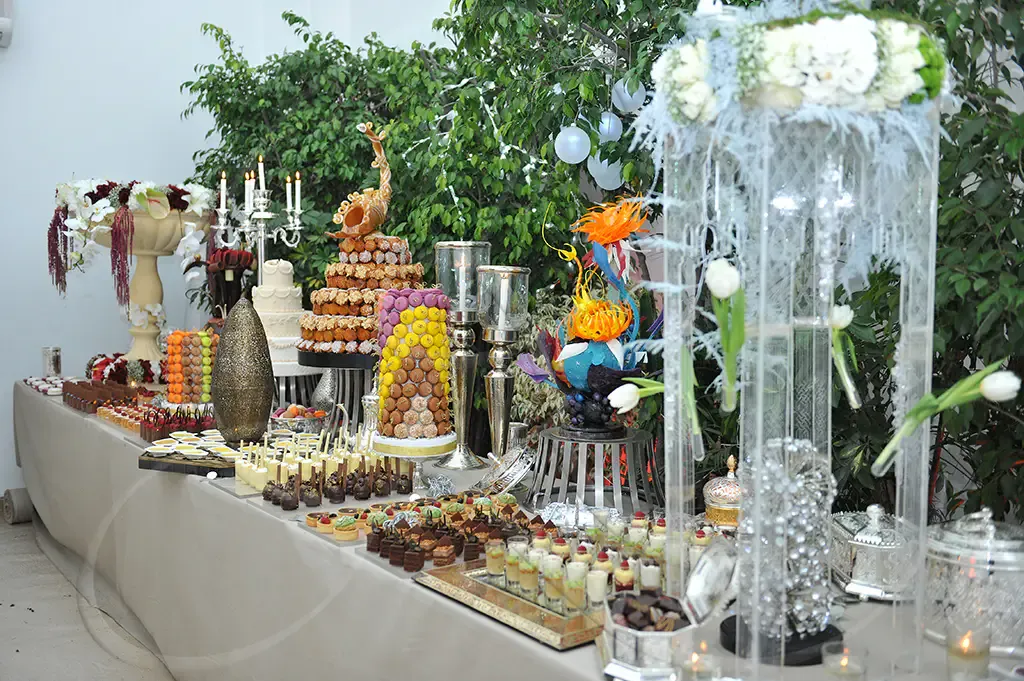
Ceremony pastry also calls for specific sourcing rigour. Fats, flours, honey, candied or fresh fruits, aromatics: every component of a fine pastry piece contributes to its final quality. Houses that control their sourcing at this level offer creations whose distinctiveness owes as much to the quality of their raw materials as to the savoir-faire of their atelier.
How can a client verify the quality of a caterer’s sourcing?
Transparency is the first indicator. A caterer who can name their regular suppliers, describe their selection criteria and explain their approach to seasonal procurement gives concrete grounds for verification. A provider who is vague on these matters often has a reason to be.
The preparatory tasting is another tool: it allows evaluation not only of culinary competence but also of the intrinsic quality of the ingredients used. An inferior product makes itself known at the table, however well prepared.
Rahal Maître Traiteur, founded in the old Medina of Casablanca, regards the rigour of its sourcing as one of the most concrete expressions of its respect for its clients. This standard is practised continuously, for every engagement, regardless of its volume or nature.
To learn more, visit the page Our Services or contact the House for an initial conversation.
Frequently asked questions
Can a caterer source locally for a reception outside Casablanca? Depending on the nature of the products and local availability, partial local sourcing is possible and often desirable for perishable fresh produce. The House evaluates this option during the preparation phase of each off-base engagement.
Are the ingredients always in season? Seasonality is a fundamental principle in menu conception. Certain specific products may be sourced out of local season when indispensable to the menu, but their availability at a sufficient quality level is verified before any commitment is made.
Is it possible to incorporate ingredients provided by the client? Yes, in certain cases and subject to validation of traceability and storage conditions. This question is addressed during menu conception, in advance of the engagement.
Is a preparatory tasting offered as a matter of course? For prestige engagements and large receptions, a preparatory tasting is recommended. It allows the client to approve the menu under its actual conditions of preparation.