In November 2016, Marrakech hosted the twenty-second Conference of the Parties on Climate Change. One hundred and ninety-six national delegations. Thousands of diplomats, journalists and representatives of international organisations. And an unprecedented logistical question for catering: who feeds this world for two weeks, to the standard that states expect for their own official receptions?
The answer was given by Rahal Maître Traiteur.
A mandate unlike any other
The appointment of a caterer to a summit of this nature is not a straightforward procurement exercise. The organisers evaluate logistical capacity, command of international sanitary standards, team availability over the duration, and the ability to absorb significant volumes without any loss of quality. Rahal Maître Traiteur met all of these criteria, as few houses in Morocco could at the time.
For the House, this mandate represented what its principals described as a national duty to be fulfilled. Not a commercial opportunity: a responsibility. Preparation took months, building the teams, calibrating the volumes, anticipating the spatial configurations and the security constraints specific to an event of this scale.
The scope of the service covered the full culinary needs of the event: working breakfasts, delegation lunches, official dinners, coffee breaks, closing buffets. A logistics operation of absolute precision, coordinated with the security teams and international accreditations required.
Moroccan gastronomy as a diplomatic statement
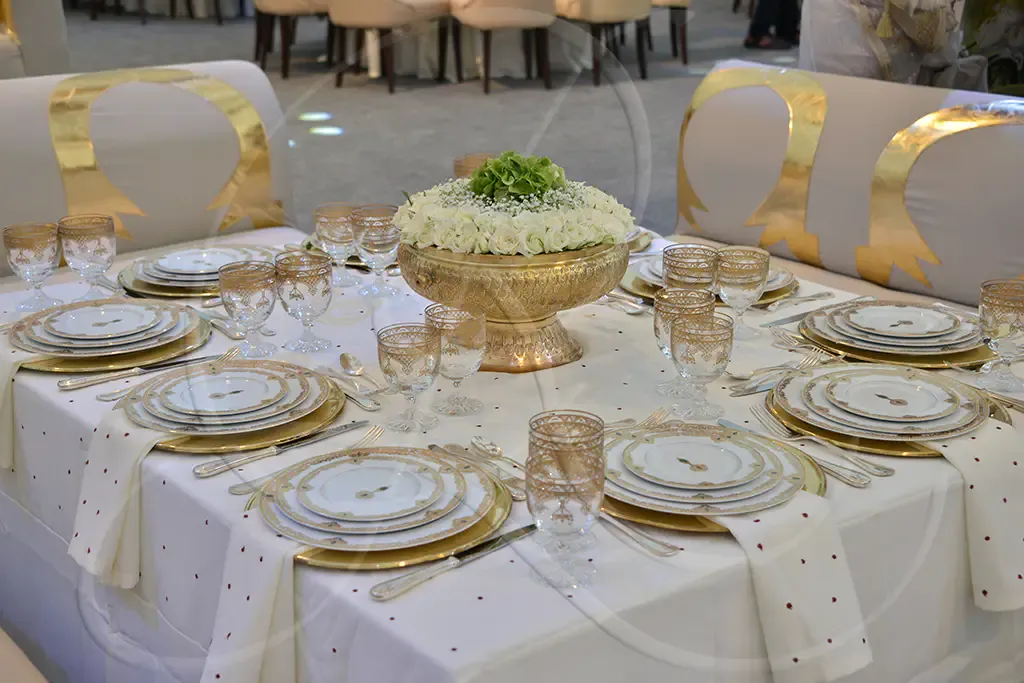
In the corridors of a diplomatic summit, the table is often the only space where delegates set aside their files and speak plainly. What is served in those moments is never incidental. Rahal Maître Traiteur understood this, and chose to present Morocco in the full breadth of its gastronomic tradition. The Moroccan culinary repertoire in all its ceremonial nobility: grand feuilleté centrepieces, slow-cooked preparations, compositions with argan oil from the Souss. The great cuisine of Morocco, without compromise.
For delegates arriving from one hundred and ninety-six countries, many were encountering the Moroccan table for the first time. What the House offered them was at once an introduction and a demonstration: that Moroccan gastronomy can hold its ground in any diplomatic context in the world.
The House had made its choice: not to dilute Moroccan cuisine into a bland universalism. Every buffet bore the signature of the land, argan, saffron from Taliouine, dates from Tafilalet, almonds from Beni Mellal.
What the press recorded
The House’s service at COP22 was covered by the Moroccan press, which noted the scale of the logistical deployment and the prominent place given to Moroccan gastronomy within a summit of this standing. The House brought to bear the certifications required by the United Nations for major international events.
What followed: COP27, IMF/WB, OIC Banjul
COP22 opened a trajectory. Rahal Maître Traiteur was engaged again to accompany the Moroccan delegation at COP27 in Egypt (2022), at the Annual Meetings of the IMF and World Bank in Marrakech (2023), and then at the Summit of the Organisation of Islamic Cooperation in Banjul, The Gambia (2024).
That trajectory says something about Rahal Maître Traiteur, and about what it represents for the institutions that entrust their mandates to it. A caterer is not re-engaged for four consecutive international summits unless the service has been equal to the occasion each time. Trust is earned at every table.
Behind these engagements stands a house founded in 1946 by a man who believed that Moroccan hospitality deserved better than improvisation. Haj Rahal Essoulami set the standard. The generations that followed have carried it to the world’s most demanding stages.